You finish Class 10, and suddenly, every adult around you turns into a strategist. One says “Science.” One says, “Commerce.” One says, “Just take whatever has scope,” which is adorable in the same way a broken umbrella is adorable in monsoon season. The problem is not that you have too few choices after 10th; it’s that you have too many choices, and most people explain them badly. In India, after 10th typically means choosing between 11th-12th streams, diploma/polytechnic routes, ITI, vocational courses, or short skill courses, and that decision shapes both your next two years and your first real career steps. This guide is for students aged 18 to 25 who want a practical answer, not a motivational poster.
The thing nobody actually says out loud
The first lie is that there is a “best” career path after 10th. There isn’t. There is only the path that fits your marks, your mood, your family situation, and how much patience you actually have for theory, pressure, and people telling you what you should have done. Most career articles pretend that every student is choosing from a clean menu. Real life is messier. Some students want a fast job. Some want a degree. Some want to earn soon and study later. Some are tired of school already and do not want another two years of sitting in a classroom pretending that enthusiasm will appear by April.
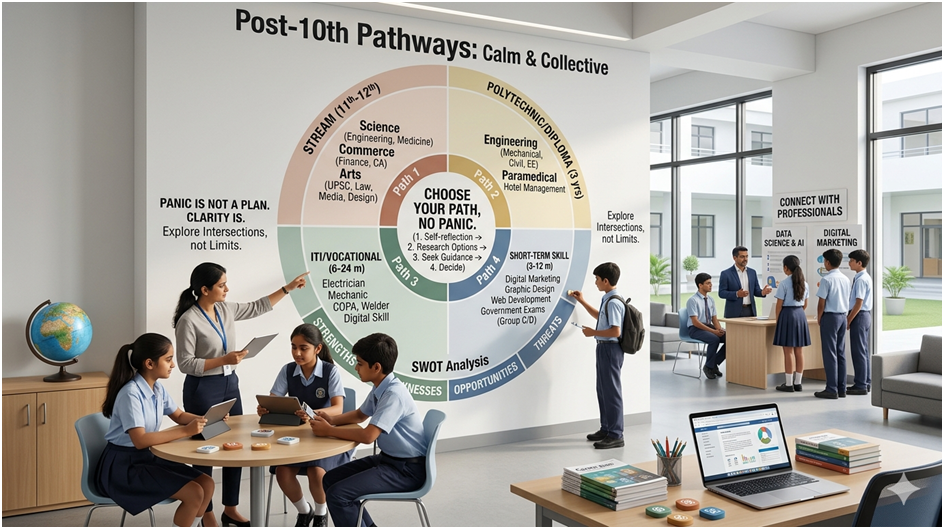
The right path after 10th is not the fanciest one. It is the one you can actually finish without hating your life halfway through. That sounds blunt because it is. A student who likes hands-on work may do better in ITI or a diploma than in an 11th-12th academic stream they never wanted in the first place. And yes, family pressure still drives a ridiculous number of choices, even when the child is the one who has to live with the result. That little detail tends to get skipped by shiny guide articles because “follow your passion” sounds better than “please stop forcing science on someone who hates chemistry.”
Think of it like picking a phone plan. You do not choose based on the most expensive option. You choose based on how you actually use it. If you only call and browse, you do not need a monster plan with features you will never touch. Career choice works the same way, except the wrong plan wastes years instead of just money.
The real mistake after 10th is not choosing the “wrong” stream. It is choosing without knowing what each path really leads to. Science, commerce, and arts are not trophies. Diploma and ITI are not backup options for people who “could not do better.” Those are lazy labels, and lazy labels cause expensive decisions.
How this actually works, the real mechanics
After 10th, your choice works in three layers. First, it affects what you study next. Second, it changes which exams and courses stay open later. Third, it changes how soon you can start earning. That is the part people forget when they only talk about “interest.” Interest matters, sure. But if your family needs income soon, or if you are already sure you want job-ready training, then timing matters too.
The most useful way to think about it is this: are you buying time, buying skills, or buying flexibility? 11th-12th gives you flexibility. Diploma gives you skills. ITI gives you speed. None of those are wrong. They just solve different problems. A student who chooses a polytechnic diploma in engineering can often enter the second year of a B.Tech later through lateral entry, which is why diplomas are not “lesser” paths; they are faster ones. That’s a detail most glossy articles skip because it ruins the snobbery.
Here is the part no one says clearly enough: your marks in 10th matter, but they do not define your future. They mostly tell you how you handled a school-style exam, not whether you will become good at accounting, coding, welding, design, healthcare, or teaching. A kid with average marks and real curiosity often outperforms a topper who was pushed into the wrong stream and now treats every study session like a minor betrayal.
A few practical patterns show up again and again:
- Science works best for students who can tolerate heavy theory, regular practice, and delayed results. It is the path people choose because it keeps the most doors open later, but it also asks for the most discipline now.
- Commerce is stronger than many families think. It is not “just accounts.” It leads to finance, business, banking, analytics, CA, CS, and management routes, which is why it suits students who like numbers, systems, and the logic of money.
- Arts is not the leftover stream. It leads to law, psychology, journalism, civil services, design, policy, and media, which are serious careers, not hobbies with paperwork.
- Diploma and ITI are for students who want practical work and earlier earning potential. They are especially useful if you learn better by doing than by listening to lectures for six hours straight.
- Skill courses like digital marketing, graphic design, or web development can be a smart side route, especially if you want to freelance or build income early. That is useful in 2026 because the internet still insists on needing people who can make things look presentable and convert attention into money.
The niche angle most guides ignore is this: after 10th, your decision is not only academic. It is also a lifestyle decision. A student who wants to start helping at home, learn quickly, or avoid a long academic tunnel should not be pushed into a route that is built for someone else’s idea of prestige. That mismatch is where regret starts. And regret, unfortunately, is not a subject in school.
Comparison what’s actually different
| Option | What it actually does | Who it’s for | The catch |
| 11th-12th stream | Keeps academic doors open for degree-based careers | Students aiming for higher studies, competitive exams, or broad flexibility | It delays income and demands patience |
| Diploma / Polytechnic | Trains you for a job-specific technical path | Students who want practical skills and earlier entry into work | You need genuine interest in the field, not just “job soon” energy |
| ITI / Vocational | Gives fast, hands-on trade skills | Students who learn by doing and want quick employability | The ceiling is lower unless you keep learning after it |
| Skill certificate | Builds a narrow marketable skill fast | Students who want freelance, side income, or digital work | Quality varies a lot, so cheap course does not equal useful course |
My recommendation: if you are still unsure, pick the path that preserves the most options, which is usually 11th-12th. If you already know you want a technical or job-first route, diploma or ITI can be smarter than forcing yourself through a path you will resent.
What actually happens when you try this
When students actually go through this decision, the first surprise is how much family opinion weighs more than aptitude. That is not a moral judgment; it is just common pattern. The second surprise is that many students do not hate a stream itself—they hate the way it was chosen for them. That matters. A student who picks Science willingly tends to stay committed longer than one who was pushed there because of “doctor, engineer, respect.”
What nobody warns you about is how quickly your daily routine changes after the 10th. In 11th-12th grade, the workload rises, and the margin for casual studying shrinks. In a diploma or ITI, the structure changes again: more practical sessions, more skills, more direct usefulness. It feels less like “school continued” and more like “now we are training for something real.” That shift can be energizing or irritating depending on whether you wanted theory or work.
There is also a weird social pattern nobody likes admitting. Students in technical or vocational routes often feel pressure to defend their choice as if they are explaining a crime. That should tell you something about the size of the ego problem around career choices in India. The smart student ignores the performance and asks a simpler question: “What will this path let me do in two years that I can actually use?”
Another thing I notice is that students who succeed after 10th usually have one thing in common. They did not try to choose the perfect life. They chose the next useful step. That is a much better mindset. Perfect decisions are mostly fictional anyway. Useful decisions pay bills.
The advice everyone gives vs what works
People love saying “choose based on interest.” That is nice advice, but incomplete. Interest without structure becomes a mood. You may like design, for example, but if you do not want to practice daily or build a portfolio, interest alone will not carry you far. The grounded version is simple: choose based on interest plus ability plus practical outcome. If all three align, good. If only one aligns, be careful.
Another common line is “Science is safest.” Safest for whom? Safety depends on whether you can handle it. Science gives flexibility and opens many career tracks, but it also needs consistency. If you dislike math, lab work, or long study hours, “safe” can turn into silent misery. A better alternative is to choose the path you can sustain, not the one that sounds impressive in relatives’ conversations.
Then there is the classic “Arts has no scope.” That is simply outdated. Arts can lead to law, journalism, psychology, public policy, civil services, and design. The real issue is not scope. The real issue is discipline and specialization. A careless Arts student may struggle, and a focused Arts student can do very well. A fourth one: “Take whatever course has the most salary.” This is how people end up in courses they hate and then blame the market. Salary matters, obviously. Nobody is doing career planning for aesthetic reasons alone. But a course with decent income and a poor fit will usually fail before a slightly lower-paying course that matches your strengths. The realistic answer is to choose a path with both employability and fit, because one without the other becomes expensive drama.
The practical part what to actually do
Start with a simple list of what you enjoy doing for real. Not what you think sounds smart. Write down subjects you can study without arguing with yourself every ten minutes, and also write down the kind of work you would rather avoid. That difference matters because career choice is less about dreams and more about repeated behavior.
Next, compare three routes only. Do not open fifty tabs and turn confusion into a hobby. Compare one academic stream, one diploma or vocational option, and one skill-based option. That gives you a realistic picture of what is available without burying you in noise.
Then talk to one person working in each route. A student brochure is polite. A real person is useful. Ask what their daily routine looks like, how hard the course actually is, and what kind of student struggles there. That last question tells you more than salary numbers ever will.
Check entry requirements early. Some diploma and ITI paths need specific subjects or minimum marks, and some courses have different admission methods. A tiny bit of planning saves a lot of awkward last-minute scrambling. Indian education systems still reward people who read the instructions instead of guessing.
Think about income timing. If your goal is to start earning soon, a diploma, ITI, or job-oriented skill course may fit better than staying in a purely academic path for two more years. If your goal is a higher-level profession later, 11th-12th may be the smarter delay. Delays are fine when they are chosen. They are painful when they happen by accident.
If you are still stuck, use one rule: do not choose a path only because other people respect it. Respect does not pay your future EMI. Fit does.
Questions people actually ask
What is the best career option after 10th in India?
There is no single best option. The best path depends on whether you want flexibility, early employment, or practical training. For many students, 11th-12th is best if they are still undecided, while diploma or ITI works better if they want skills and earlier earning. The “best” option is the one you can actually commit to.
Should I choose Science after 10th?
Choose science only if you can handle regular study, logic-heavy subjects, and a longer academic route. It is a good option for engineering, medicine, and technology careers, but it is not a status upgrade. If you hate the subjects already, do not expect the next two years to feel magical.
Is Commerce a good career path after 10th?
Yes, very much so. Commerce leads to CA, CS, banking, finance, business, and management careers, and it suits students who like numbers, systems, and practical decision-making. It is not a “safe fallback”; it is a serious track with real outcomes.
Is Arts good after 10th for a career?
Yes. Arts is a strong option for law, psychology, journalism, civil services, design, and public policy. The bad reputation mostly comes from people who have not looked beyond old-school stereo types. The stream is only weak when the student is weakly supported.
Which course after 10th gives a job जल्दी?
If quick employability is the goal, ITI, vocational courses, and some diplomas are the fastest routes. They focus on job-ready skills instead of broad academic study. That said, speed matters only if the course quality is decent and the student keeps building skills after finishing it.
Can I change my career later if I choose the wrong stream?
Yes, in many cases you can, but it is easier to choose well now than to fix a mismatch later. Many career changes happen through higher education, bridge courses, or skill-building over time. The real trick is not to panic. Most paths are not permanent traps, but they do shape your starting point.
Is diploma’s after 10th better than 11nth and 12th?
Better for some students, worse for others. Diploma is useful if you want practical training and earlier work opportunities, while 11th-12th is better if you want academic flexibility. If you already know your field and want hands-on learning, diploma can be a smarter choice.
How do I decide on my career if I am confused after 10th?
Use a short checklist: subject interest, learning style, income goal, and long-term target. Then compare one academic route, one job-oriented route, and one skill-based route side by side. Confusion usually gets smaller when you stop trying to evaluate everything at once.
Do 10th marks decide my career?
No, they do not decide it. They matter for some admissions, but they are not a prophecy. Marks show exam performance, not whether you will do well in a career path that matches your interests and strengths.
So, where does this leave you?
It leaves you with a slightly annoying truth: the right career path after 10th is not found by asking who sounds most confident in the family group chat. It is found by matching your strengths, your patience, your money needs, and your willingness to keep going when the novelty wears off. That is less glamorous than people want, but it is also how real decisions work.
If you want one thing to do today, make a three-column note: “I like,” “I can tolerate,” and “I want after 2 years.” Then put Science, Commerce, Arts, Diploma, and ITI under it and see what survives the handwriting test. That simple exercise does more useful work than most “career motivation” speeches ever will.
Conclusion
You made it this far, which is already a better sign than choosing a stream because your cousin said it looked nice. The honest version is that there is no perfect option after 10th, only a better-fit option with fewer regrets.
The students who do well are usually not the ones who picked the coolest path. They are the ones who picked a path they could live with and then got serious about it. That is the part people skip because it is less dramatic. Still true, though.