You finish graduation, and suddenly everyone asks the same question: “So, what now?” As if a degree comes with a hidden coupon for a stable job and a polite salary. It doesn’t. What you actually get is a crowded field of government exams, each with different eligibility rules, exam patterns, and timelines that somehow always feel more urgent than they look on paper. This guide cuts through that noise and focuses on the exams graduates in India should actually keep on their radar in 2026. No fantasy. No “just prepare smart” nonsense. Just the list, the differences, and where each one fits.
The thing nobody actually says out loud
The real issue after graduation is not “which exam is best.” It is choosing the right battle before you waste a year pretending every exam is equally worth your time. That is how people end up preparing for six exams at once and mastering none of them. The government-exam world rewards focus more than enthusiasm, and that sounds harsh only because it is true. Most articles sell you the idea that all you need is discipline and a timetable. Cute. In practice, the bigger decision is whether you want an exam that matches your degree, your age, your comfort with competition, and your patience for long preparation cycles. UPSC, SSC, Railways, banking, state PSCs, and teaching exams all sit in the same broad universe, but they do very different things for your life. A graduate chasing a high-ranking civil service role needs a different plan than someone who wants a stable clerical or supervisory job sooner.
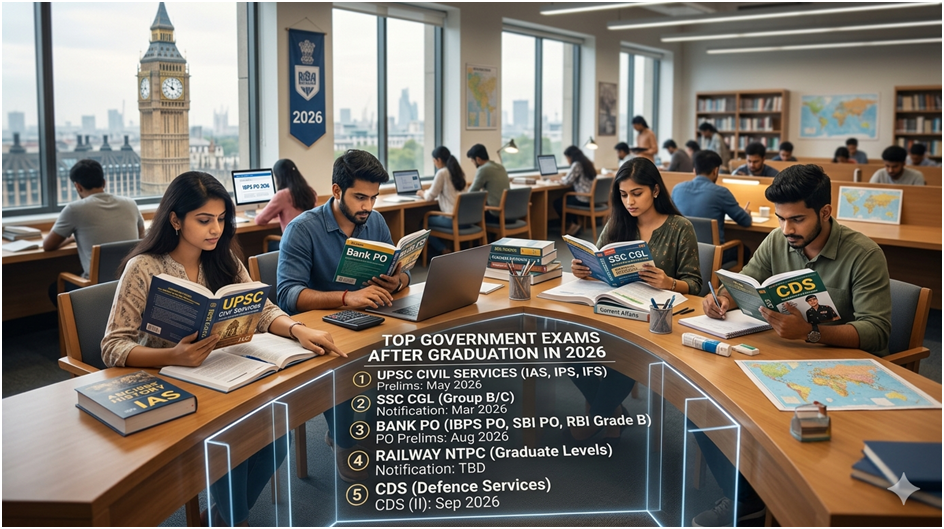
The smartest preparation starts with narrowing the exam list, not expanding it. That is the line most coaching ads would rather you never hear. They benefit when you keep believing every exam is your exam. You do not need to prepare for the entire country. You need to prepare for the one or two routes that suit your degree, age, and work style.
And yes, that means some exams should be ignored completely. Not forever. Just for now. A year spent preparing badly is still a year spent badly.
How this actually works, the real mechanics
Government exams after graduation are not in one category. They are a stack of different systems. Some are open to almost any graduate. Some need a specific degree. Some have age limits that quietly decide your entire strategy. Once you understand that, the fog starts clearing.
The first split is broad-based recruitment versus specialized recruitment. UPSC CSE is broad-based and highly selective, with the 2026 notification released and prelims scheduled for 24 May 2026. SSC CGL is also broad-based, but it usually targets graduate-level central government posts with a different style of preparation and a much more exam-heavy mindset. Banking exams like IBPS PO and SBI PO are built around aptitude, speed, and a very different kind of pressure. State PSCs are closer to UPSC in structure but smaller in scale and more state-specific.
The second split is job type. Some exams lead to administrative posts. Some lead to clerical roles. Some lead to technical or semi-technical positions. That matters because the exam you choose should match the kind of work you are actually willing to do every day, not just the title you can brag about for three seconds at a family function.
A few practical observations matter here:
- UPSC is for people willing to play the long game. It is not just an exam; it is a lifestyle for a while, and the 2026 cycle shows the usual tight calendar and early deadlines.
- SSC CGL is the classic graduate route if you want central government jobs without signing up for civil services-level uncertainty.
- Banking exams suit people who can stay fast, accurate, and calm under repeated mocks. The exam pattern punishes sloppiness more than many students expect.
- Railways remain attractive for graduates who want scale, stability, and a recruitment ecosystem that often feels more straightforward than the rumor mill around it.
- State PSCs are smart for candidates who want to work within their state and can align with local language and syllabus realities.
- Teaching and university-level eligibility exams fit candidates who want an academic or classroom-oriented path rather than a general administrative track.
The niche angle most generic guides ignore is timing. In 2026, the real question is not just “which exam exists?” It is “Which exam still has an open window that matches my degree and age right now?” That is why calendar awareness matters. SSC’s 2026–27 calendar shows several graduate-level notifications and exam windows spread across the year, including CGL, JE, CHSL, Stenographer, and MTS cycles. If you plan like everyone else, you lose months.
Comparison what’s actually different
| Option | What it actually does | Who it’s for | The catch |
| UPSC CSE | Tests for top administrative and service roles | Candidates ready for long prep and high competition | Huge syllabus, long timeline, low selection rate |
| SSC CGL | Opens graduate-level central government posts | Graduates wanting stable government work with a broad net | Lots of competition and speed-based sections |
| Banking PO/Clerk | Recruits for public sector banking jobs | Candidates comfortable with aptitude and quick problem-solving | Repeated phases, high time pressure |
| Railways recruitment | Offers large-volume government jobs | People who want stability and practical recruitment options | Role variety is wide, so post quality varies |
| State PSC | Selects for state-level administrative posts | State-focused graduates and local aspirants | Syllabus and competitions differ by state |
My take: if you are serious but unsure, start with SSC CGL or a banking track while keeping UPSC only if you genuinely want the long haul. If you already know you want top administrative services, do not dilute that focus with ten side goals. That is how people end up “preparing” forever and applying nowhere.
What actually happens when you try this
When you start preparing for graduate-level government exams, the first thing that hits you is how much of the work is not glamorous at all. It is arithmetic, reading speed, revision, and the boring discipline of doing the same thing again when the result does not arrive immediately. That is the part coaching reels forget to mention because nobody puts “revised 80 pages today” on a motivational thumbnail.
The thing that surprises most first-time aspirants is how much the exam calendar shapes daily life. For example, UPSC CSE 2026 had a clear notification and prelims timeline, which means your preparation is not abstract anymore once the dates are visible on the page. SSC calendars work the same way; once you see notification windows and exam months laid out for CGL, CHSL, JE, Stenographer, and MTS, you stop preparing “someday” and start preparing against actual deadlines. Deadlines are rude, but effective.
Another pattern that many articles miss is this: candidates often underestimate the cost of switching exams. The syllabus overlap is real, but not complete. Someone who prepares for UPSC and then jumps to banking without adjusting speed and pattern practice usually wastes momentum. Someone who does SSC-only practice and then suddenly tries civil services gets crushed by the scale of the syllabus.
You also notice, after a few mock tests, that your comfort with one subject can hide your weakness in another. A candidate may feel strong in current affairs but lose marks in reasoning or quant. That creates a false sense of readiness. Real exam prep becomes less about confidence and more about correcting the one section you keep avoiding.
And yes, there is a practical difference between wanting a government job and wanting a government career. One is about entry. The other is about growth, transfers, promotion ladders, and the kind of work you will still be doing five years later. That’s not a small distinction. It decides whether your effort turns into a job or a path.
The advice everyone gives vs what works
“Apply to every exam you can.” That sounds practical. It is usually terrible advice. If you are weak on focus, applying to everything becomes emotional collecting, not preparing. The realistic version is to apply only to exams that match your degree, age, and the kind of work you actually want, then build a serious plan around those two or three options.
“UPSC is the only respected exam.” No. It is the most famous, not the only valuable one. SSC, banking, railways, and state PSC roles all offer real careers with stability and progression. The claim that only one route has status is usually made by people who have never read a notification in their life. Choose based on fit, not applause.
“Just start with current affairs.” That is how beginners feel busy while avoiding the hard parts. Current affairs matter, yes, especially for UPSC and state-level exams, but they do not replace static subjects, practice papers, and revision. The grounded method is to split your time between current affairs, subject basics, and exam-style testing from the start.
“Coaching is mandatory.” Sometimes useful, never mandatory. Some students need structure. Some need accountability. Some just need a quiet room, a syllabus, and a refusal to romanticize struggle. The honest alternative is to use coaching only if it gives you a real framework, not because fear told you it was the only route.
“More exams mean more chances.” Not if your preparation gets thinner every time you add one more target. This is one of those ideas that sounds ambitious and behaves like a trap. A narrow list usually creates better results than a crowded one because your revision becomes sharper and your mock test pattern improves faster.
The practical part what to actually do
Make a shortlist of three exams, not ten. One should be your main target, one should be a backup with similar syllabus overlap, and one should be a lower-risk option that keeps you moving. That way, your preparation stack works like a ladder instead of a pile of unrelated folders.
Check the eligibility details before you fall in love with the exam name. Age limits, degree requirements, and category rules change the game more than people admit. The 2026 UPSC and SSC calendars make it obvious that deadlines and eligibility windows are not decorative information.
Build a weekly plan around sections, not vague hours. For example, one block for quant or reasoning, one for static subjects, one for current affairs, and one for mock analysis. Mock analysis matters more than mock count after a point. A student who reviews mistakes properly improves faster than one who keeps taking tests like pain is a hobby.
Use last year’s papers early. Not after six months. Early. Past papers show the exam’s real behavior, and that matters because many test series are too polished to teach you the real difficulty level. The paper is the paper. Everything else is rehearsal.
Keep one source for current affairs and stop collecting random PDFs. Too much material creates the illusion of progress while quietly killing revision quality. If your notes are a junk drawer, your memory will act like one.
Set a deadline for your first serious mock cycle. Not “soon.” A real date. Then treat the results as information, not as a verdict on your intelligence. Most aspirants fail because they interpret a weak score emotionally instead of technically.
Questions people actually ask
Which government exam is best after graduation in 2026?
The best exam depends on your goal. If you want top administrative services and are ready for long preparation, UPSC CSE is the big one. If you want a stable graduate-level government job with a wider set of posts, SSC CGL is often the smarter starting point. There is no single answer that fits everyone.
Can I prepare for UPSC and SSC together?
Yes, but only if you are disciplined about overlap. The first stage can overlap in general studies, reasoning, and current affairs, but the depth and style are not the same. Many students try both and end up preparing neither properly. If you combine them, keep UPSC as the main plan and SSC as the practical backup.
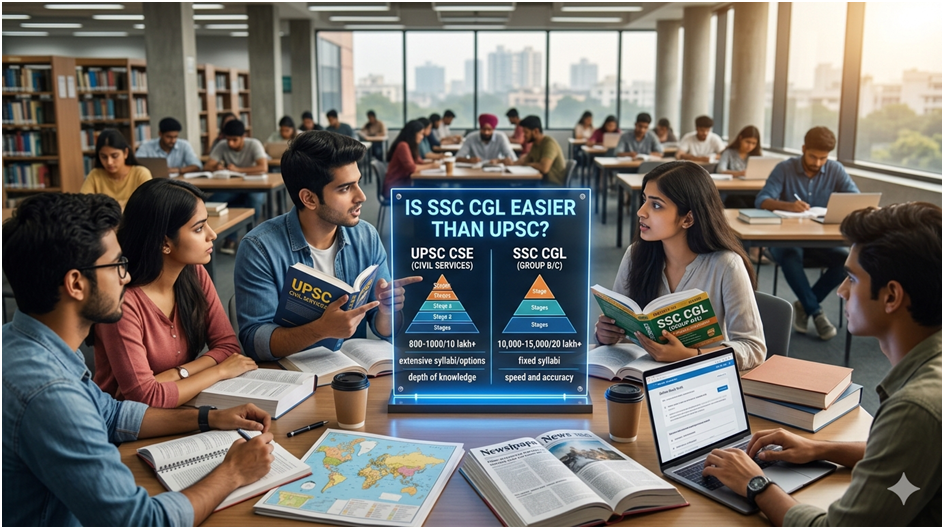
Is SSC CGL easier than UPSC?
Yes, in the basic sense that SSC CGL is narrower and more exam-focused than UPSC CSE. That does not mean it is easy. It still needs speed, accuracy, and serious competition handling. “Easier” in government exams usually means “less impossible,” which is not the same thing.
What are the top government exams for graduates?
The main ones in 2026 include UPSC CSE, SSC CGL, banking exams like PO and clerk tracks, Railway recruitment exams, and state PSC exams. Which one matters most depends on your degree and your target job. A graduate should pick based on fit, not hype.
Do railway jobs still have openings for graduates in 2026?
Yes. Railway recruitment remains one of the biggest government employment routes, and 2026 notifications have included large-volume posts such as Group D and other board-level recruitments. The exact post depends on the notification and qualification. Read the category carefully because “railway job” is not one single thing.
What is the age limit for government exams after graduation?
There is no universal age limit. UPSC, SSC, Railways, banks, and state PSCs all have different rules. That is why checking the official notice matters before spending months preparing. Age eligibility can quietly remove an exam from your list.
Which exam should a fresher start with?
A fresher should start with the exam that has the closest fit to their degree, age, and preparation style. For many graduates, SSC CGL or a banking exam is a more practical entry point than jumping straight into the longest route available. If you truly want civil services, then start UPSC early and accept that it is a longer project.
Can I get a government job without coaching?
Yes. Coaching helps some people, but it is not a requirement. Many candidates prepare with self-study, mock tests, and good discipline. What matters more is consistency than whether your notes came from a classroom or your own desk.
So where does this leave you?
It leaves you with a simple rule: do not prepare for “government exams” as a giant cloud. Pick the exact exam family, read the calendar, and build your week around that. The 2026 schedules for UPSC and SSC already show why timing matters more than confidence speeches.
One concrete thing to do today: shortlist three exams, open their latest eligibility rules, and mark the next application deadline in your calendar. That one step is more useful than ten motivational videos and a new notebook with a clean first page.
The truth is that this path is not romantic. It is repetitive, competitive, and sometimes boring. But boring is often what finally works. You made it to the end, which probably means you are more serious than the average “which exam is best?” searcher. Good. Now act like it and choose a lane.